Travel Guide · Ancient History
Exploring Malta’s Ancient Temples
Standing inside these limestone walls, you quickly realise something remarkable — these temples were already old when the pyramids were being built.
When most people think of Malta, they picture the baroque grandeur of Valletta, the ancient streets of Mdina, or the deep blue of the Mediterranean. But tucked into the southern hillsides of this small island lies something far older — and arguably far more extraordinary.
Malta’s prehistoric temples are among the oldest free-standing stone structures in the entire world. They predate Egypt’s Great Pyramid by around 1,000 years and Stonehenge by several centuries. Yet remarkably few travellers make the journey out to see them. If you do, you will have a genuine encounter with some of humanity’s earliest builders — and it is an experience that stays with you long after you leave the island.
Who Built These Temples — and When?
The temples were built by a mysterious prehistoric civilisation that settled Malta around 5000 BC, most likely arriving from nearby Sicily. Over roughly 2,500 years, these people developed a sophisticated culture — one that constructed enormous limestone temples aligned precisely with the movements of the sun.
They had no metal tools. They had no wheel. Yet they quarried and moved stone blocks weighing several tonnes, shaping them with astonishing precision and decorating them with carved spiral patterns and animal reliefs. They also created some of the earliest known figurines of the human form — the famous “fat lady” or Venus figurines found at several temple sites.
Then, around 2500 BC, this entire civilisation disappeared — almost overnight in archaeological terms. No one knows exactly why. Climate change, disease, and resource exhaustion have all been suggested. They left behind no written language, no clear successors, and no explanation. Only the stones remain.
The Temples You Should Visit
There are several temple complexes across Malta and Gozo, each with its own character and atmosphere. Here are the ones worth putting on your itinerary.
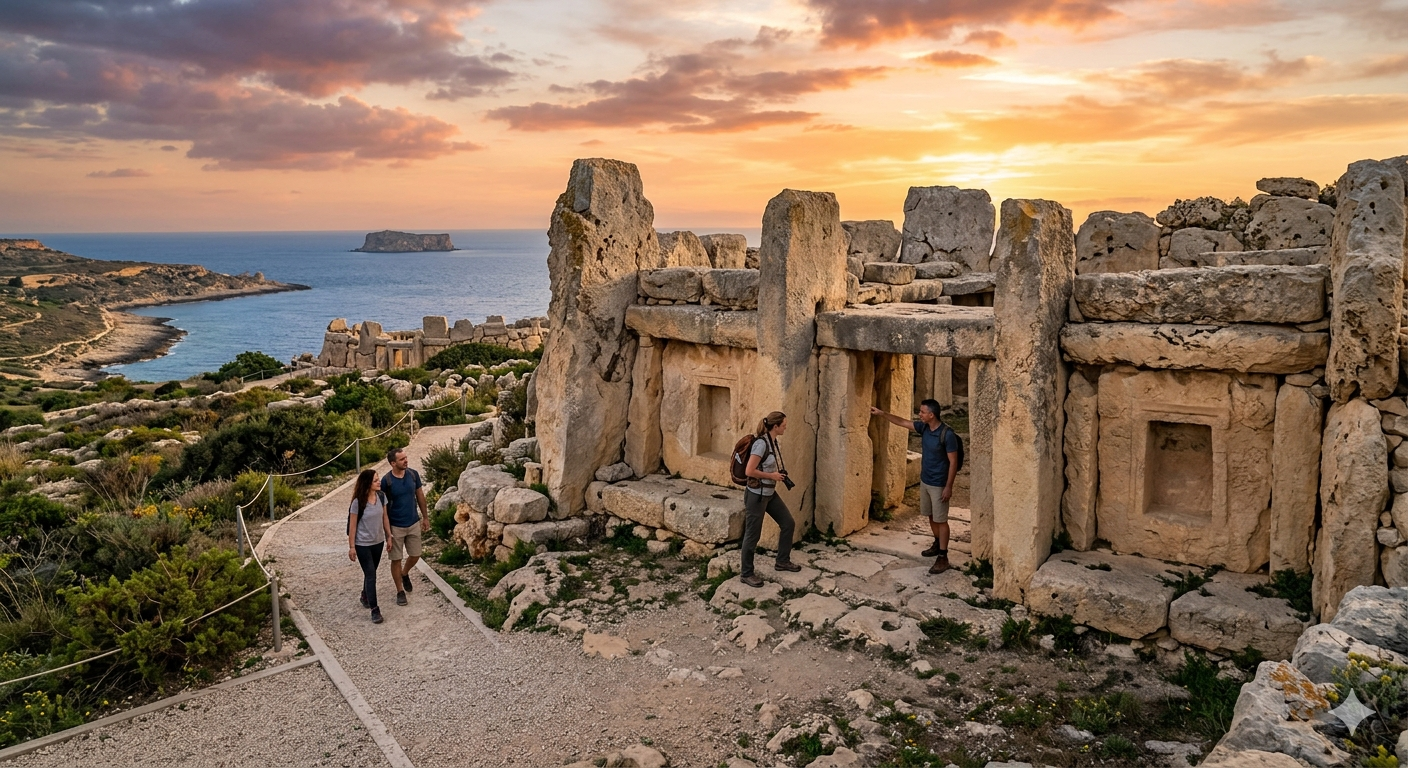
Perched on a dramatic clifftop overlooking the sea, Ħaġar Qim is arguably the most photogenic of all the temple sites. The name means “Standing Stones” in Maltese. Its massive facade stones are among the largest used in any of the temples, with one block weighing an estimated 20 tonnes. At the summer solstice sunrise, light passes through a specific doorway and illuminates a carved stone altar — a breathtaking moment of ancient astronomical precision.
A short walk downhill from Ħaġar Qim, Mnajdra is a complex of three connected temples set in a natural hollow above the sea. It is considered one of the best-preserved prehistoric sites in the world. The southern temple in particular functions as a near-perfect solar calendar — light enters different doorways precisely at each solstice and equinox. Walking through it, you sense real intelligence at work in its design.
On the sister island of Gozo, Ġgantija is the oldest of all the UNESCO temple sites — built around 3600 BC, making it one of the oldest man-made religious structures on Earth. Its name means “Giant’s Tower” in Maltese; local folklore once held that only giants could have moved such enormous stones. The outer walls still stand to a height of around 6 metres. Visiting Gozo for Ġgantija alone is worth the ferry crossing.
Located in a quiet residential neighbourhood, the Tarxien complex is easy to overlook on a map — but it is extraordinary up close. It contains some of the finest decorative stonework of any Maltese temple, including beautifully carved spiral reliefs and the lower half of a monumental statue that originally stood over 2.5 metres tall. The site also reveals evidence of a later Bronze Age cremation cemetery, showing how these places remained sacred long after their builders were gone.
Mnajdra temple complex, overlooking the southern coast of Malta
The Hal Saflieni Hypogeum: Underground and Unforgettable
No visit to Malta’s prehistoric world is complete without the Hypogeum — and it is unlike anything else on this island, or anywhere else in the world.
Discovered accidentally in 1902 during construction work, the Hypogeum is an entirely underground sanctuary carved into the rock over three levels, descending about 10 metres below the surface. It served as both a temple and a burial site — the remains of over 7,000 people were found within its chambers, along with exquisite pottery and figurines.
Deep inside the Hypogeum is a small niche known as the Oracle Room. A low male voice spoken into it resonates through the entire underground complex with an extraordinary, almost supernatural quality. Researchers believe this effect was intentional — and possibly used during rituals to create a sense of divine communication. It is one of the most haunting experiences Malta has to offer.
Visitor numbers are strictly limited to just 80 people per day to protect the site, so booking well in advance is essential. It is worth every effort to secure a ticket.
Practical Tips for Visiting
Planning your temple visit well makes a real difference. Here is what you should know before you go.
Book the Hypogeum online weeks in advance — it sells out fast and walk-ins are not accepted. Visit heritagemalta.mt to reserve your spot.
Ħaġar Qim and Mnajdra are open-air sites — go early in the morning in summer to avoid the heat and crowds. Both sites now have protective tent covers over the main structures.
Ħaġar Qim and Mnajdra are just a 5-minute walk apart and share a car park, so visit both together. Combined tickets are available.
For Ġgantija on Gozo, take the Gozo Ferry from Ċirkewwa — the crossing takes about 25 minutes and runs frequently throughout the day.
Audio guides are included at most sites and add real depth to the experience. The Heritage Malta museum near Ħaġar Qim is small but excellent — don’t skip it.
Why These Temples Still Matter
What makes Malta’s temples genuinely moving — beyond the impressive scale of the stones — is how little we know about the people who built them. They lived on this small island for thousands of years, developed a rich spiritual culture, built structures of remarkable sophistication, and then vanished without trace. No successor civilisation carried their language, their beliefs, or their memory forward.
In an age when we can research almost anything, standing in a place that still holds so much mystery feels rare and precious. The spirals carved into the stone at Tarxien, the precise solar alignments at Mnajdra, the haunting resonance of the Oracle Chamber — all of it points to a people who were thoughtful, creative, and deeply connected to the world around them.
Malta does not just have old ruins. It has the oldest temples in the world — and they are still standing, still beautiful, and still largely undiscovered by the crowds who fill Valletta’s streets each summer. That, in itself, is reason enough to go.
Whether you are a history enthusiast, a curious traveller, or simply someone who loves standing in places that feel truly ancient, Malta’s prehistoric temples will leave a lasting impression. They are not just a footnote to the island’s story — they are its oldest chapter, and one of the most remarkable in all of human history.
Plan a morning at Ħaġar Qim and Mnajdra, an afternoon at the Hypogeum, and a day trip to Ġgantija on Gozo. You will return home with a very different understanding of just how old human civilisation really is.
Explore more: discover the medieval streets of Mdina or the baroque grandeur of Valletta on beautifulmalta.com