
There are places in Malta that look good in photos and then disappoint you when you actually show up. St Peter’s Pool is not one of them. If anything, it looks even better in person than anything you have seen online, and once you have been, you will understand why locals keep coming back to it all summer long.
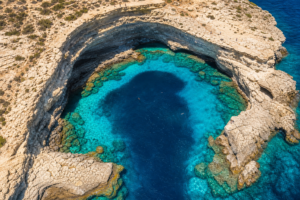
This is not a beach in the traditional sense. There is no sand, no sunbeds, no beach bar with overpriced cocktails. It is a natural limestone inlet on the southeastern tip of Malta where the sea has carved out a sheltered pool surrounded by flat white rocks and low cliffs. The water inside is calm, clear, and a shade of turquoise that honestly does not look real on a sunny day.
So Where Exactly Is It?
St Peter’s Pool sits on the Delimara Peninsula, which is the little arm of land that sticks out on Malta’s southeastern coast. The nearest village is Marsaxlokk, which is about 10 minutes away by car. From Valletta you are looking at roughly 25 to 30 minutes depending on traffic. It is not far from anywhere in Malta, but the road in the final stretch is narrow and single track, so the drive feels a bit more of an adventure than the distance suggests.
First Time There – Here Is What to Expect
You park up, walk a short distance, and then descend steep stone steps cut into the cliff to reach the rocks below. The steps are manageable but not gentle, so flip flops are a bad idea for this part even if they are fine once you are on the flat limestone.
When you get down, you are standing on wide flat rock with the pool in front of you. The water is remarkably clear – you can see the bottom easily even in the deeper sections. It genuinely looks like something from a travel documentary.
The geology here is the real story behind why it looks the way it does. The limestone that forms these cliffs was laid down long before humans ever walked these islands. Mediterranean waves worked at it relentlessly over thousands of years, exploiting softer zones and carving them away faster than the harder rock around them. That differential erosion is what created the horseshoe shape you see today – the softer zones became the curved interior of the pool, while the harder bands of limestone held firm and formed the dramatic ledges where people now jump. The shape was not designed. It was worn into existence.
The water color is what makes the photographs work, and there is a specific reason for it. Limestone bedrock reflects sunlight differently than sand or a silty bottom. In the shallows the water appears bright turquoise, and toward the center it shifts into a deeper blue. That gradient is entirely down to light bouncing off white rock at different depths. The paler and shallower the rock below, the brighter the color above it.
There is no shade anywhere on the rocks. The limestone absorbs heat and the sun reflects off it, so it gets intense by mid-morning. Bring sunscreen and more water than you think you will need.
What People Actually Come Here to Do
Swimming is the main event and the water is well suited to it. The inlet is sheltered enough that even when the open sea outside is a bit rough, the pool inside stays relatively calm. The clarity makes it feel safe and clean, and snorkeling is excellent because visibility is so good you can see the rock formations and small fish below without any effort.
Cliff jumping is the other big draw, especially for younger visitors. The rocks around the pool have entry points at different heights, starting from low sections of around 2 to 3 meters and going up to higher jumps that require a bit more nerve. The flat top of the limestone makes it easy to approach, look down, and decide whether you want to commit. Always check that the water below is clear of other swimmers before jumping, and never dive head first.
Sunbathing on the warm rock is genuinely comfortable once you settle in. People spread out towels, find a spot that works for them, and stay for hours. The rock holds heat well and the surrounding scenery makes it easy to just sit and do nothing for a while.
The pool has its own piece of internet history worth knowing. A Jack Russell named Titti became globally famous for jumping off the cliffs here alongside his owner, Carmelo Abela. The videos went properly viral and drew visitors from all over the world who wanted to see it for themselves. Titti died in 2019 but inspired a wave of imitators and left a real mark on the place. A successor dog named Tina has since taken up the tradition. If you are there on the right day and spot a small dog launching itself off the limestone into the sea, now you know the story.
Getting There Without the Stress
Car is the most straightforward option and what most people use. Set your navigation to St Peter’s Pool Malta and it takes you there directly. The last stretch of road is narrow with blind bends, so drive slowly and use your horn around corners to let oncoming drivers know you are there.
There are two parking spots. One is a paid private car park right next to the cliff access, costing around 3 euros per day. The other is a free car park a short walk further back. In summer the paid one fills up fast. Getting there before 9 in the morning makes a real difference, both for parking and for avoiding the crowds on the rocks.
If you do not have a car, take bus Route 81 from Valletta to Marsaxlokk and get off at Abdosir, or Route 119 which goes closer to the Delimara area. From either stop you are walking around 20 to 30 minutes to reach the pool. That is fine in cooler months but worth thinking through carefully if you are visiting in the height of summer.
The most enjoyable alternative to driving is actually arriving by boat. Small boat trips leave from Marsaxlokk harbour for around 5 to 10 euros per person and sail along the coast to St Peter’s Pool. You see the cliffs from the sea before you see them from above, which is a completely different experience and well worth doing if you have the time.
Pairing It with Marsaxlokk
If you are going to St Peter’s Pool, spending time in Marsaxlokk on the same visit is an obvious and worthwhile addition. The village is 10 minutes away and is one of the most genuinely charming spots in Malta – a working fishing harbour with brightly painted traditional boats called luzzus lined up along the waterfront.
The Sunday fish market is the best time to visit Marsaxlokk. The seafood restaurants along the harbour are good value and the atmosphere is relaxed in a way that feels local rather than touristy. Combining the two makes for a solid full day in the south without needing to cover too much ground.
The Delimara area around the pool also has Delimara Fort, a British-built structure from the 1870s, and the old Delimara Lighthouse nearby if you feel like a short explore after swimming.
When to Go and When to Avoid
May through September is the right window for swimming. The water is warm, the sun is reliable, and the late afternoon light on the pale limestone is beautiful. Peak summer weekends in July and August get genuinely busy and parking becomes a real issue by mid-morning. Early arrival solves most of this.
May, early June, September, and October are the sweet spot. Still warm enough to swim, noticeably fewer people, and the overall experience is more relaxed. Winter visits are possible for the scenery and a walk, but the water is cold and swimming is not really on the cards.
One thing to check before you go in late summer is jellyfish. They appear occasionally around August and September and vary from year to year. A quick search or asking locally before heading down is worth a few seconds of your time.
A Few Things Worth Knowing
There is a small cash-only kiosk near the parking area selling drinks, ice cream, and snacks. No cards accepted, so bring cash. There are no public toilets at the pool. There is no lifeguard on duty at any point, so the usual responsibility applies. The walk back up the steps after a full day in the sun is more tiring than the way down – do not underestimate it.
Is It Actually Worth the Trip?
Yes, genuinely. St Peter’s Pool is one of those places that delivers what it promises without dressing it up. Clear water, dramatic rock, a natural setting that feels a long way from the tourist trail even though it is not far from anywhere.
It is not comfortable in a resort way and that is exactly the point. You get out what you put in, and most people who go leave wishing they had stayed longer.
The Basics
- Location – Delimara Peninsula, southeastern Malta, near Marsaxlokk
- Entry – Free
- Parking – Free car park available, paid option near the steps at around 3 euros
- Open – All year, 24 hours
- Best months – May to September for swimming
- Time to allow – 2 to 3 hours at least
- Facilities – Cash-only kiosk, no toilets, no lifeguard
- Best way to get there – Car, or boat trip from Marsaxlokk harbour
Also worth reading – our guide to Marsaxlokk village and the best natural spots in Malta.